Wednesday, 22 February 2012

Digital games market could be worth $53B by 2016


"Angry Birds" is spearheading the growth in digital games.


Is there anywhere Angry Birds won't go?

Research firm Ovum doesn't think so, and expects hits such as Angry Birds to drive growth in the digital gaming market. The firm predicts that the market, which comprises any online games played on the PC, console, or smartphone, will double over the next five years to $53 billion.

The market for mobile gaming alone is expected to triple to $17.5 billion by 2016, Ovum said.

"With the addition of more and more casual gamers, the market is no longer the sole preserve of the teen male hardcore gamer," said Ovum analyst Mark Little. "Gaming is fast establishing itself with a much wider mainstream audience, with serious ramifications for other rich-media entertainment such as TV, video and music."

Just take "Call of Duty: Modern Warfare 3," which launched this week amid massive fanfare and a blockbuster film-like marketing campaign. Gamers are expected to flood the virtual battlefield to fight it out, as well as pay for premium Elite offerings that provide advantages and additional services.


Activision, which publishes Modern Warfare 3, is expected to bolster sales with additional downloads and maps, for a price.

"Game publishers' evolving strategy is turning game products into game services, extending product life with downloadable content that continually refreshes a title's ability to engage the gamer," Little said.

The online bonuses typically yield higher margins than the game itself, he added.

On the mobile side, developers are expanding the market by offering games that can be played for free, offering up incentives, new levels and upgrades as premium products. The free-to-play model has driven further adoption as more casual gamers use their smartphones as entertainment devices.

Hack Microsoft.com


Go to http://www.microsoft.com

Add this text after http://www.microsoft.com

“/library/gallery/components/ratingcontrol/CustomError.aspx?m=HACKED%20BY%20YourNameHere”

How To Enable Facebook Timeline Right This Second

How To Enable Facebook Timeline Right This Second


timeline
This morning Facebook announced Timeline, a crazy (and kind of creepy) omnibus look at everything that has ever happened in your Facebook lifespan. It’s like a story book of your life — or at least the online, documented parts.
Facebook said that Timeline would be on the way for everyone sometime in the coming weeks… which is great and all, for everyone else. You’re the type of person who reads TechFun, and are thus likely the type of person who likes their new and shiny things right now.
That’s okay. We can make it happen.
Fortunately, enabling Timeline a bit early isn’t too difficult — but it’s not at all straight forward, either.
You see, Facebook is enabling Timeline early for open graph developers. You, too, can be an open graph developer — even if you’re just looking to dabble.
A few things to note:
- You probably don’t want to do this unless you’re actually a developer. Expect bugs.
- Only you will see your timeline at first (unless you decide otherwise), but it will automatically go public after a few days. My timeline was automatically hard-set to go public on September 29th.
- It seems that if you login into Facebook on another machine, Timeline gets disabled automatically on all of your machines. With that said, it seems you can get back to your timeline (but ONLY after following the steps below) by navigating to http://www.facebook.com/YOURUSERNAMEHERE?sk=timeline
- You’ll need to have a “verified” account for one of the steps, which means you need a credit card or phone number attached to the account.

Here’s how to do it:

1. Log into Facebook
2. Enable developer mode, if you haven’t already. To do this, type “developer” into the Facebook search box, click the first result (it should be an app made by Facebook with a few hundred thousand users), and add the app.
3. Jump into the developer app (if Facebook doesn’t put you there automatically, it should be in your left-hand tool bar)

4. Create a new app (don’t worry — you wont actually be submitting this for anyone else to see/use). Give your shiny new app any display name and namespace you see fit. Read through and agree to the Platform Privacy agreement. This is the step you need to be verified for.

5. Ensure you’re in your new app’s main settings screen. You should see your app’s name near the top of the page

6. Look for the “Open Graph” header, and click the “Get Started using open graph” link.

Create a test action for your app, like “read” a “book”, or “eat” a “sandwich”


7. This should drop you into an action type configuration page. Change a few of the default settings (I changed the past tense of “read” to “redd” — again, only you can see this unless you try and submit your application to the public directory), and click through all three pages of settings

8. Wait 2-3 minutes

9. Go back to your Facebook homescreen. An invite to try Timeline should be waiting at the top of the page

And you’re done! We’ve seen this work quite a few times now, so it should work without a hitch for just about anyone.

Microsoft, Yahoo, AOL team up to sell Internet ads


Microsoft, Yahoo and AOL are joining forces in an online advertising attack on Google and Facebook.

The alliance, announced on Tuesday, is designed to sell some of the less-prized ad space that Microsoft Corp. Yahoo Inc. and AOL Inc. have had trouble filling on their own.

Even as they share some resources, the three companies vowed to retain their independence and compete against each other with separate sales teams. For that reason, they said they don't expect U.S. antitrust regulators to object to the nonexclusive partnership before they begin selling ads together in January.

Ross Levinsohn, a Yahoo executive vice president, hailed the alliance as a "fundamental rethinking" of the Internet ad market.

That statement also could be interpreted as a bit of wishful thinking. Microsoft, Yahoo and AOL all need to change the direction of an online ad market that has been increasingly tilting in the direction of Google and Facebook.

Having already built a money-making machine in its dominant search engine, Google Inc. has become even more powerful in Internet marketing since it bought DoubleClick's ad service for $3.2 billion in 2008. That deal provided Google with a springboard to leap from text ads that appear next to search results into the graphical messages known as display advertising.

Facebook is attracting more advertising as it becomes more established as the Internet's most popular hangout. The company accumulates valuable insights into people's interests as its 800 million users share their passions. That advantage has helped Facebook become the leader in U.S. display advertising with a 16 percent share of the online ad market, according to the research firm eMarketer Inc.

Yahoo, the former leader, has seen its share fall from 18 percent in 2008 to 13 percent this year. Google's share of the display market has risen from 2 percent in 2008 to 9 percent.

Microsoft stands at 5 percent and AOL is hovering around 4 percent, according to eMarketer.

As it has fallen further behind in Internet advertising, Microsoft's online division has piled up operating losses of $7 billion since June 2008. Revenue at both Yahoo and AOL is steadily falling. Yahoo has been struggling so much that its board is mulling whether to sell all or part of the company.

Microsoft may eventually benefit from Facebook's success. It bought a 1.6 percent stake in Facebook for $240 million in 2007. By some estimates, Facebook is now worth three to five times more than it was when Microsoft made its investment.

By tapping into each other's technology, Microsoft, Yahoo, and AOL are betting they can save money and sell more advertising.

The partnership will cover a category of advertising that doesn't typically appear in the prime slots on websites. Microsoft, Yahoo and AOL believe that space will be in higher demand if they can succeed at creating a more efficient, transparent market that helps connect advertisers with the Web audiences best suited for their marketing campaigns.

AT&T to Offer Smartphones for One Cent on Black Friday


If wireless products are topping this year’s present wish lists, AT&T has you covered with a Thanksgiving weekend of promotions.
Starting at 12:01 a.m. on Black Friday, AT&T’s website deals page will unveil sales on touchscreen devices (yes, including tablets) with new gadget deals rolling out each day through Monday. The rest of the weekend features:
  • Saturday, Nov. 26 - All Windows 7 and certain Android devices are available for one cent.
  • Sunday, Nov. 27 – The BlackBerry 9860 is one cent and HTC’s Red Inspire is $30.
  • Monday, Nov. 28 - Select smartphones including the Motorola Atrix, Samsung Infuse, and HTC Inspire sell for one cent.
The deals come with a few strings; all require a two-year service plan, smartphones require AT&T voice and the minimum $15 monthly data plan, and messaging devices must be purchased with a minimum $20 monthly messaging plan.
Be sure to check out our Black Friday deal roundup page for more Black Friday deals.

How To How to delete all your Facebook posts and comments

Maybe you woke up from a long night and realize you've made a horrible mistake, posting dozens of embarrassing pictures (or worse) to Facebook. Maybe you've just decided that your five years on Facebook were experimental and you'd rather move on.
In either case, deleting more than a couple of posts or pictures can be a major pain. There is a neat Android tool called Exfoliate that can scour your Facebook history and permanently delete some or all content. (iPhone users should see it come to the App Store soon.) Here's how to use it: 
Facebook Wall before Exfoliate.
  1. Install Exfoliate from the Android Market.
  2. Tell Exfoliate which data to delete. This is mostly straightforward, organized into time and content type. If things don't seem to work out the first time, try again with Background Override checked. If you're on a network you trust, you can uncheck Use Https Only to speed up the operation considerably. 
    Step 2: Choose data to delete.
    Step 2: Choose data to delete.
  3. Sign in to Facebook. Exfoliate doesn't retain your log-in information. 
  4. Authorize Exfoliate as a Facebook app. It needs a lot of permissions, as it has a lot of work to do. 
  5. Now is your last chance to reconsider. Start Exfoliate by tapping the big button on the bottom of the screen. 
    Step 5: Begin processing.
    Step 5: Begin processing.
  6. If you get cold feet or suddenly remember you need to save a pic or two, you may have a chance to stop some deletions. Exfoliate starts with the oldest data, so you can tap the cancel button and hope you caught it in time. If not, it's gone forever, so think carefully. 
  7. This is a slow process. If you're deleting more than a few posts, you should probably leave it running and plugged in overnight. 
    Facebook Wall after Exfoliate.
    Facebook Wall after Exfoliate.
That's it. As with any other app or service that makes irrevocable changes, you should think carefully before using it. For some users, though, Exfoliate could be a life-saver.

Live Video Chat with Rihanna navy

                                                      Event Starts- Sunday, December 25' 2011
                                                      4:00 pm to 8:00 pm


CHAT WITH RIHANNA NAVY LIVE!


rihannalive on livestream.com. Broadcast Live Free

How Ferrari's F1 technology works


So there we were, inside the Ferrari Garage at Greater NOIDA's Buddh International Circuit, just 24 hours before the first practice session of the first ever Indian Grand Prix.

We saw the Ferrari engineers assemble cars for both Fernando Alonso and Felipe Massa. We discovered in detail the workings of the pit lane garage and how the team of engineers piece together a complex chain of events which result in the most exhaustive bit of teamwork in sports.

In the Ferrari Garage we ran into Scuderia Ferrari's chief techie, Andrea Beneventi. His official designation is Head of Electronics for Track and Test and Head of Support for Electronic Applications, and he gave us a deep insight into the technological aspects of Scuderia Ferrari's F1 enterprise. Take a moment to read the technical jargon - behind it lies a fascinating account of the incredible systems that go into putting a car on the track.


Some key elements he touched upon are as follows:

1. Computers and Servers: It's easy to assume that F1 cars are all about horsepower, but because of the level of sophistication of these vehicles, there is a massive synergy between software and hardware, both at the Ferrari Garage on the track and at Ferrari HQ in Maranello. The Ferrari Team uses a legion of Acer Laptops, Servers and Rack based machines among whom most run Quad-Core Processors tied in with 8GB of RAM which also run specially tailored software meant for data collection, telemetry and the works. The machines that the Ferrari team travels around the world with are generally portable, and along with these workstations the team also employs a myriad of displays, again provided by Acer. On the whole it seems that Ferrari not only employs some serious horsepower for their engines but also for their computing needs. Pretty impressive, right? We have more.

2. Communication is key: This is pretty much a well-known fact but the level the Ferrari team takes this to is almost unheard of. Apparently real-time Telemetry is shared between the car and the Ferrari Garage in the pit lane and between the factory in Maranello. Now how does this happen? This happens via Controller Area Network (CAN) lines and Ethernet lines. The CAN lines are connected to RF arrays, which are in turn connected to a series of antennae placed throughout the circuit enabling wireless real-time telemetry to the garage. From here, the engineers can change the programme parameters of the car. For the link up between the track server and Maranello, Ferrari uses Multiprotocol Label Switching Network (MPLS), which enables very high data, transfer speeds of upto 6 MegaBits/ second. In fact, the guys in Maranello even have access to the communication between the drivers and the pit-lane engineers.


By the way, CAN is an automotive protocol which is even used in our regular vehicles. Beneventi says that the robust nature of the protocol makes it ideal even for Formula 1 cars.

3. Data Analysis and Telemetry: Communication and computing power exists primarily to facilitate Data Analysis, Simulations, and real time telemetry. According to Beneventi, the team collects about 2 to 3 GB of data for one car over the course of a race weekend, which is stored in the main server in the pit garage.

This also automatically synchronizes with Ferrari's mainframe back in Maranello over their MPLS network. It is on the basis of this data and real time telemetry that the team plans its race strategy and further wind tunnel development of the car.

4. Research and Development Coupled with Innovation: Ever since 2008, the FIA has brought about stringent Electronic Control Unit protocols, where all performance related enhancements remain constant for all constructors, and only car management ECUs can be custom built by the constructors. This has resulted in a situation where some of the richer constructors like Ferrari do not gain performance advantages due to their financial might where their car development budgets could sky rocket, but this situation does leave minimal wiggle room for constructors to innovate on F1 technologies. According to Beneventi, this is not an entirely bad thing: while it does slash budgets, it also forces the team to innovate on different technologies. For instance, an F1 car is fitted with an Apotation Meter, which is basically a sensor that helps the engineers monitor the positioning of various components inside the car.


With the new rules, Ferrari makes its F1 cars on almost 1/4th of the budget that it used to, which led the team to develop a brand new technology from scratch for the Apotation Meter as there previous technology would not fit in the budget. In spite of the new budgetary restrictions, Beneventi mentions the newer generation Ferrari F1 cars are equipped with far more sophisticated gadgetry than their predecessors, which were developed on higher budgets.

Some Key Technical Terms:

MPLS Network: Multiprotocol Label Switching (MPLS) is a mechanism in high-performance telecommunications networks that directs data from one network node to the next based on shortpath labels rather than long network addresses, avoiding complex lookups in a routing table.

Controller Area Network: Controller-area network (CAN or CAN-bus) is a vehicle bus standard designed to allow micro-controllers and devices to communicate with each other within a vehicle without a host computer.

Wind Tunnel: A wind tunnel is a research tool used in aerodynamic research to study the effects of air moving past solid objects. Formula 1 constructors use it for the development of aerodynamic efficiency of their vehicles. It is a key process in development of the car and goes on through out the year.

Electronic Control Unit: In automotive electronics, electronic control unit (ECU) is a generic term for any embedded system that controls one or more of the electrical systems or subsystems in a motor car.

Siri-like voice recognition coming to cars


Siri on the iPhone 4S(Credit: AppleiPhonefive.in)

Smartphones raised the bar for hands-free voice activated technology, and consumers are starting to expect the same level of intuitive usability in their cars. But they'll have to wait until next year to find it.

The Detroit Free Press reported that at the Nuance Automotive Forum in Detroit this week, speech-recognition company Nuance said an auto manufacturer will integrate advanced voice command technology into its vehicles next year. Nuance's connected car product manager, Ed Chrumka, said the new systems will enable drivers to make natural-language requests in their vehicles to initiate tasks such as making dinner reservations.

Nuance's speech recognition is already used in several infotainment systems, such as Ford's Sync and GM's IntelliLink. It's also the brains behind Siri's genielike capabilities. But most OEM systems support only 50 or 60 terse voice commands to facilitate hands-free navigation or calling. Ford is the exception, its Sync system recognizing 10,000 voice commands.

However, it's getting to the point that even 10,000 voice commands isn't enough, especially when you want the system to be able to look up directions, suggest restaurants, or shop for you. Existing navigation systems expect you to know and manually enter the address of your destination, which is beginning to feel antiquated. For vehicles that allow voice input for directions, the menus are long, laborious, and often just as distracting to navigate as using a touch screen. Siri-like voice systems in vehicles are desperately needed for automakers to keep up with consumer expectations.

Apple has shown auto manufacturers the right way to do voice commands, and according to Nuance, at least one manufacturer will step up to the plate. However, it's not as simple as copying the implementation. Manufacturers have greater liability concerns and need to grapple with the issue of distracted driving. They also need to be able to provide navigation and directions without relying on mobile networks for data connections, which can be spotty in some areas.

Nuance didn't say which carmaker will be implementing its advanced voice recognition system. However, Mercedes-Benz is expected to reveal an iPhone-centric infotainment system in a vehicle next year.

Windows 8 plans to better manage your battery life


(Credit: Screenshot by Lance Whitney/CNET)

Designing Windows 8 for virtually any device from smartphone to PC, Microsoft says it's had a key goal in mind for all hardware platforms--energy efficiency.

With laptops and mobile devices slurping up battery power and desktops and servers chewing up electricity, Microsoft has wanted to ensure that any device running Windows 8 can tap into better power management.

"Very small changes done well in Windows can result in very large positive environmental impact because of our scale," Pat Stemen, a program manager on Microsoft's Kernel team, said in the latest Building Windows 8 blog. "In many markets around the world, increasing electricity consumption is putting more demand on every aspect of the workplace to reduce power consumption. PCs are a significant source of potential savings."

Software itself can impact power usage, noted Stemen, since the CPU, hard disk, memory, and other components each consume resources. The operating system and drivers also play a role since they manage the hardware.

With energy savings in mind, Stemen says that Windows 8 has been designed with three goals:

• Aim for power efficiency on all types of hardware. Whether someone is using a WindowsTablets or a powerful gaming machine, the idea was to standardize on the same power management features to be consistent across all platforms.

• Provide improved battery life. Windows 7 offered a large reduction in energy use, particularly in the battery life of mobile PCs, said Stemen, and the goal with Windows 8 is simply to maintain that same level amid all the feature changes.

• Apply the smartphone power model to PCs. Smartphones, tablets, and other mobile devices can quickly switch in and out of a low-power mode so they're instantly available when you need them. Microsoft's intent is to apply that same technique to computers running Windows 8.

Looking at Windows 8 itself, Stemen said that the new OS offers three "key innovations to improve how software influences power consumption." Those include the Metro style app model, idle activity, and a new device power management framework.

Metro apps can potentially be running all the time, delivering news, e-mail, and other updates. But Microsoft designed the Metro model so that apps retreat into the background when not needed so as to consume less power. To gauge this, the new Task Manager in Windows 8 shows which specific Metro apps are suspended.


Idle activity is a measure of how much power a component is consuming even when it's idle. In Windows 8, Microsoft has improved the idle activity through what it calls idle hygiene, thereby consuming less power in certain situations.

Finally, Microsoft has created a new device power framework in Windows 8, especially tweaked for mobile devices. The new framework lets devices "advertise" their power management abilities so they can work with a new Windows 8 driver designed to optimize energy usage.

"Battery life and power consumption continue to be some of the most important topics in the computing industry," Stemed noted. "We wanted to give you a look at how we think about power management for Windows 8, and how we measure power consumption on a daily basis. We consider power management a core OS capability that is critical on any chip architecture and any PC form factor."

Domino’s Lets You Make a Pizza On Your iPad and Then Order it in Real Life


Domino’s Pizza has found a novel way to engage iPad users and maybe sell a few more pizzas along the way. The pizza chain has created an app that lets you make a pizza onscreen and then order it in real life.
Domino’s Pizza Hero is a game/app that simulates the experience of kneading dough, spreading sauce, sprinkling cheese, placing toppings and cutting slices all while a timer ticks away. The object is to make the pizza as quickly as possible and to closely mimic the experience of real Domino’s workers. For instance, levels one through five of the game are called “Pizza School,” just like the real program at Domino’s. When you get to level six, your scores are based on reviews from in-game customers much like a fake version of the Domino’s Tracker, the company’s real-time feed of consumer comments.
Players can compete against each other on a leaderboard and share their scores on Facebook and Twitter. Players can also hit the “Make An Order” tab within the app to order their creations via Dominos.com. A rep for the ad agency behind the app, Crispin Porter + Bogusky, says that there are parameters regarding the type of pizza you can make. You can’t, for instance, knead the dough into the shape of Florida or have a pizza that’s got sauce only on one half.
The app is likely the first iPad game from a pizza purveyor, but it is not the first iPad pizza app. Pizza Hutpaved the way in May with an app that lets you order a pizza from your iPad. Domino’s, meanwhile, released asimilar app for the U.K. market in August. The app is clever. Though, if it ever crashes, you could just use your iPad’s browser to visit Dominos.com and order a pie.

Amazing Technology coming in January - EXOdesk

ExoPC's 40-inch multitouch EXOdesk is coming in 2012 for $1,299 (video)


We haven't even made it to Black Friday yet, and already we're getting a taste of the futuristic swag that'll be on display at CES in January. Over the weekend, ExoPC posted a video teasing a multitouch surface called the EXOdesk, promising more details when the show kicks off after the new year. The desk measures 40 inches (make that "40 high-definition inches") and, as you'd expect, supports a smorgasboard of multi-fingered gestures. The entire teaser lasts less than a minute, but you don't need more than a few seconds to realize this isn't the same UI we reviewed with the the ExoPC Slate. So far, we noticed you can run apps at full-screen and swipe widgets to chuck 'em out of sight. You can also swipe the corner with four fingers to reveal what appears to be an RSS feed, and then swipe individual items to make them disappear. That's all we know about how it works, though the company did reveal it'll go on sale next year for $1,299 -- a fraction of the $8,400 you'll pay for the new Samsung SUR40 running Microsoft Surface. We'll be keeping an eye out for this when we stake out CES in January, but until then, we've got the teaser vid tucked after the break.

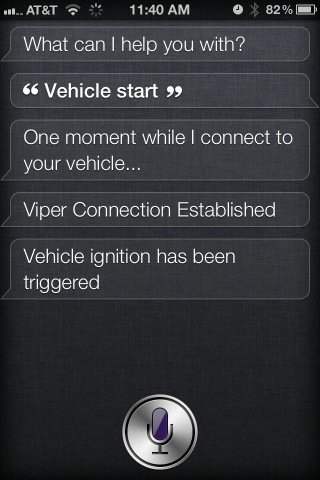
Amazing => Siri - Start My Car


Siri - Vehicle Start
Yes, it really does control my car! ;)
I created a new ruby plugin that is used by plamoni's "Siri Proxy", a proxy server for Apple's Siri assistant. This proxy server allows for the creation of custom plugins that can intercept recognized speech and perform virtually any function imaginable (programmable, scriptable).
The "Siri Proxy" plugin I wrote handles interaction with a php script that runs on my web server. The php script, which I developed months ago for personal use, allows me to send commands to my car which has a Viper SmartStartmodule installed.
Current commands accepted are: "Vehicle Arm", "Vehicle Disarm", "Vehicle Start", "Vehicle Stop", "Vehicle Pop Trunk", and "Vehicle Panic".
--UPDATE: Now it also responds to more conversational commands such as "Start my car", "Lock my car", "Pop my trunk", etc...
I may change the command wording a bit later.  This was just a proof of concept. We'll see.
Technical Details:
  • Siri Proxy & DNSMasq box - Ubuntu 11.04 Server VM
    Ruby 1.9.3
  • LAMP server - Ubuntu 10.04 LTS Serve

A simple Siri hack essentially allows users to control their vehicles with their voices. Using the Viper Control plugin and Siri Proxy, Brandon Fiquett uploaded a video on YouTube demonstrating the capabilities of Apple’s voice-activated technology when it’s been connected to a Cobra remote starter.

The video above shows Fiquett starting and stopping the ignition of his Acura TL car by simply speaking these commands into his iPhone using the Siri app. Fiquett explains that the “command is sent from Siri to a Viper server, then relayed via cellular connection to the car. The car then broadcasts an update via RF to the key chain remote.” The hack can also lock and unlock the car and also pop open the trunk.

Bajaj Pulsar with Mono-Suspension - Coming this December!

Bajaj Pulsar with Mono-Suspension - Coming this December!
Like Bajaj Pulsar On Facebook!

Pulsar is one brand of bikes in India which has succeeded after makeovers and upgrades in every single form right from its inception. The story goes back to as early as 2001 when the first generation Pulsar with no headlamp fairing and round bare speedo dials swayed the market which ended up making great market share for Bajaj Auto. This particular model though was the first Pulsar in the country still makes good deal in the used bike market owing to its macho looks.

Let’s stop talking about history and come back to the topic now. We just had a news about a couple of weeks back or so that the visually tweaked Pulsar doesn’t match and cope up to the expectations of the customers and hence was off the track compared with the hypes created in the market in regard with this model. But, that visually upgraded (or merely dual tone painted) Pulsars are not the next generation Pulsar. The 2012 model will be out by the end of this year, anytime in the month of December.
Bajaj Auto has confirmed this much awaited news and it is observed that this launch will be to commemorate 10 years of success of Pulsar brand in India. Off late, Bajaj Auto decided to make every product of it as an individual brand, following which Pulsar became a brand by itself. But, this was just a part of marketing strategy which the nation’s second largest two wheeler manufacturer came up with.
In a recent interview, Mr. Rajiv Bajaj, MD, Bajaj Auto said. “The new Pulsar will be 100 percent brand new and will come with technology better than the current DTS-i. The new technology is the next level for motorcycles, not just the next level for Bajaj.” This statement finally makes the news official, marking an end to all the rumours spreading across the internet and various other sources as well.
                                               Like Bajaj Pulsar On Facebook! 
Industry sources reveal that the 2012 Pulsar will not be a mere upgrade of the existing model, but will be an entirely all new product raised from ground zero.  Mr. Rajiv Bajaj also added, “We launched the first Pulsar in November 2001 and are now ready with a 100 per cent new bike with remarkable engine technology. It is really the next big step after DTS-i.”
Mr. Bajaj also claims that the next generation Pulsar will sport technologies and features which no other Indian bike has seen or experienced so far. This creates more hype for the next breed of Pulsars. Pulsar is still the lifeline for Bajaj Auto in making record sales year after year. So, there are even chances that a higher displacement Pulsar to be on the queue. There are in fact chances for a 250 cc bike from the company’s stable.
The MDof Bajaj Auto also said, “Our market share is going to stay at 27 per cent for now, but as the Boxer catches on and as we introduce the new Pulsar in January, I certainly hope that we will gain market share. I hope for 30 per cent market share by the time we finish this fiscal year.” When he was the details of the engine that the new bike will sport, he said that the details will be out in due course of time.
There are also chances that this bike will be based on the platform of Austrian brand KTM, on which Bajaj Auto holds 39 per cent stake. The Duke 200 will anyways be showcased in the Delhi Auto Expo which is scheduled to happen on the month of December. So, though we cannot comment about the platform on which the Pulsar will be based, there are high possibilities for this to happen.
Though the 2012 Pulsar will be showcased by the end of this year, it will rock the roads only by next year for that’s when the bike will come alive to its production stage. The company is also planning to invest approximate sum of around INR 500 crores in the financial year 2013 as part of its expansion plans.
So, can it be said that the wait is finally over? What do you guys expect from the next gen Pulsar? Do you think it will be worth the wait and will surely be ‘THE’ bike which many of you are waiting for? Leave your comments in the form of words below.